How can you find the perfect entry on a meme coin without chasing the pump?
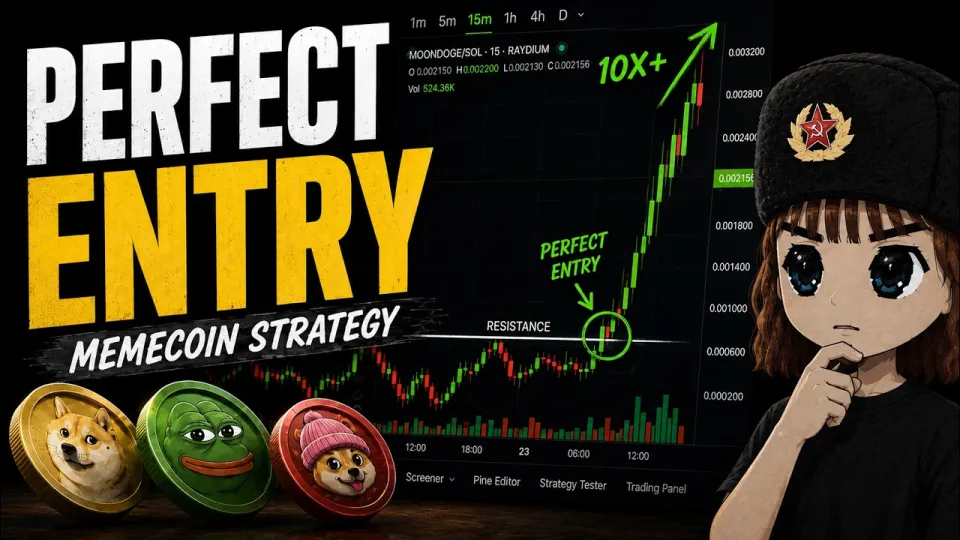
Video: How I Find the PERFECT Entry on Memecoins 📈 (Full Strategy)
Need articles like this for your video? They help promote it on YouTube and Google — order them in the Telegram bot @sat_sit_bot. The bot writes and publishes the articles itself (with your YouTube video embedded) on popular topical websites (no ads). Try it free: 50 articles on us.
· based on the channel starwifpump
A meme coin entry is a planned decision, not a reaction to a green candle: you pick a token with visible liquidity and structure, wait for momentum confirmation, then buy a pullback into support with a predefined invalidation level and position size. Most traders lose on meme coins because they enter at the wrong moment, not because they picked the wrong ticker. The full breakdown of that process comes from the starwifpump channel, and the tool stack the author points to for paper trading, sniping and copy trading is available through the Plasma Telegram early-access link.
Why the entry point decides the outcome of a meme coin trade
Entry price sets the entire risk-to-reward ratio of a meme coin trade, so the same token can be a good trade or a bad one depending on where you click buy. A token bought at the top of an extended candle needs a much larger move just to break even, while the same token bought on a controlled pullback can be stopped out cheaply if the thesis fails. That asymmetry is the whole argument for spending more time on the chart and less time on the narrative.
Meme coins add two complications that blue-chip assets do not have. First, liquidity is thin and can disappear, so slippage and exit depth matter as much as the entry candle. Second, attention moves in hours, which means a setup that looks valid on a 1-minute chart can be invalidated by a single large seller. Treat every entry as a trade with a defined loss, not as a lottery ticket.
The pre-entry checklist before you buy any meme coin
Before looking for a pattern, confirm that the token is even tradable: this checklist filters out most of the charts that are not worth your attention.
- Liquidity and holder distribution. Check pool depth, the share held by the top wallets and whether the contract has obvious red flags. Thin liquidity means your exit is someone else's decision.
- Chart structure. Higher lows and clear reaction levels beat a vertical line with no base. If you cannot draw a support level, you cannot plan an invalidation point.
- Volume behaviour. Rising volume on the move up and falling volume on the pullback is the healthy pattern. Volume that spikes only on the way down is distribution.
- Catalyst status. Know whether the narrative is fresh or already three days old. Late entries into a tired narrative are the classic FOMO trap.
- Your own plan. Size, stop and first target written down before the order, not after.
How to read momentum on a meme coin chart without chasing
Momentum is information about who is in control, not a signal to buy immediately at market. The practical way to use it is to let the first impulse happen, then watch how the price behaves when it pauses.
- Impulse and pause. A strong move followed by a tight, shallow consolidation suggests buyers are still holding. A move followed by a deep, sloppy retrace suggests the impulse was mostly late chasers.
- Candle character. Long upper wicks and closes near the low of the range after a big run point to sellers absorbing demand.
- Time spent at highs. Price that keeps grinding sideways just under resistance is usually building for continuation; price that immediately dumps from resistance failed the test.
- Volume on the retrace. The pullback you want to buy is the one where volume dries up, not the one where every bounce is sold into.
Where to actually enter: pullbacks, support and confirmation
A high-quality meme coin entry is usually a pullback into a level that already proved itself, confirmed by a reaction candle. Three variants cover most situations:
- Retest of the breakout level. Price breaks a prior range high, comes back to that level, and holds. Entry on the hold, stop just below the level.
- Higher-low continuation. After an impulse, price prints a higher low above the previous base. Entry on the reclaim of the local high, stop under the higher low.
- Deep flush into a known demand zone. A fast drop into a level where buyers previously stepped in, with the first strong close back up as confirmation. This is the highest-risk variant and deserves the smallest size.
In all three cases the rule is the same: the stop goes where the idea is wrong, and the position size is calculated from that stop distance, not from how much you want to make.
The chart signals that tell you not to enter
Knowing when to skip a trade protects capital more reliably than any entry pattern. The clearest warnings are structural: a series of lower highs, a breakdown of the level that supported the last leg, or a chart that only moves on isolated spikes with no follow-through. A token that has already printed several vertical legs in a short window is also a poor entry, because the remaining upside is shared with everyone who bought earlier and is waiting to sell.
Behavioural warnings matter too. If you find yourself refreshing the chart every few seconds, sizing up because you missed the first move, or looking for a reason to justify an entry you already made, the setup has stopped being a setup. The author of the breakdown frames this as a repeatable process rather than prediction, and the same logic appears in the viewer discussion: people ask about trackers and filters because they want a system, not a hot tip.
Risk, exits and profit-taking planned before the trade
Risk planning turns an entry into a trade: define the invalidation level, the position size, and the first partial exit before the order goes in. A common structure is to take a portion off at the first resistance or at a fixed multiple of risk, move the stop to break even, and let the remainder run only while the structure holds. On meme coins, where a single wallet can move the price, taking partials is not a lack of conviction; it is how you survive a series of trades.
Position sizing deserves the same discipline. If a stop-out costs more than a small, pre-agreed percentage of your trading capital, the position is too large regardless of how good the chart looks. Beginners in the comments often describe starting with a few hundred dollars, which is exactly the right scale to practise entries without turning a lesson into a loss that ends the hobby.
Common questions from traders learning meme coin entries
The recurring doubts in the audience discussion are practical rather than theoretical: which chain to trade, which tools to use, and how to find tokens before they move. On chains, the mechanics of an entry are the same everywhere, but liquidity depth, trading costs and the quality of the tooling differ, so start where you can actually see the order flow and exit cleanly. On tools, trackers and terminals help with discovery and execution, but they do not replace the checklist above; a filter that surfaces a hundred tokens per hour is useless without a rule for rejecting most of them.
On discovery, social trackers can flag attention early, yet the entry still has to come from the chart. And on the emotional side, the most common story is losing money by buying green candles, then stepping away. The honest answer is that a smaller size, a written stop and a rule to skip messy charts address the actual cause of those losses.
Useful links
- Plasma Telegram early access — paper trading, real trading, sniping, copy trading and position tracking in one place.
- Discord community — live trades and discussion.
- Padre terminal VIP access
- Solpump
- starwifpump on X
Final takeaway
A meme coin entry is a process, not a moment: filter the token, read the structure, wait for momentum to pause, buy the pullback with a stop where the idea breaks, and size the position from that stop. The chart work matters more than the narrative, and skipping a bad setup is a decision that pays as well as a good trade. The starwifpump channel built this framework around exactly that idea, and it is worth working through with small size before applying it to real capital. If you want the tool stack used for paper trading and live execution, start with the Plasma Telegram early-access link.
Key takeaways
- Most meme coin losses come from timing the entry, not from picking the wrong token.
- Quality setups are built on structure, momentum and a pullback into support, not on a green candle.
- A predefined invalidation level and position size matter more than the size of the expected pump.
- Chasing an extended candle destroys the risk-to-reward ratio before the trade even starts.
- Skipping a messy chart is a valid decision: patience is part of the process.
Source: How I Find the PERFECT Entry on Memecoins 📈 (Full Strategy) · Markdown version
Questions & answers
How do I know if a meme coin entry is good before I buy?
A good entry has three parts: a level that already proved itself as support or resistance, a confirmation candle showing buyers are still in control, and a stop placed where the idea is clearly wrong. If you cannot define that stop level, the entry is not planned yet.
Should I buy the first green candle on a new meme coin?
Usually not. The first impulse is where late chasers get trapped, and buying its top destroys your risk-to-reward. Waiting for a pause or a pullback into support costs some upside but gives you a defined invalidation level.
Which chain is best for trading meme coins?
The mechanics are the same across chains, but liquidity depth, fees and tooling quality differ. Trade where you can see the order flow and exit without heavy slippage, and check holder distribution and pool depth before sizing up.
How much should a beginner risk on a single meme coin trade?
Small enough that a full stop-out does not affect your ability to take the next trade. Many traders start with a few hundred dollars and a fixed percentage of that per position, taking partial profits early rather than holding for an unrealistic target.